
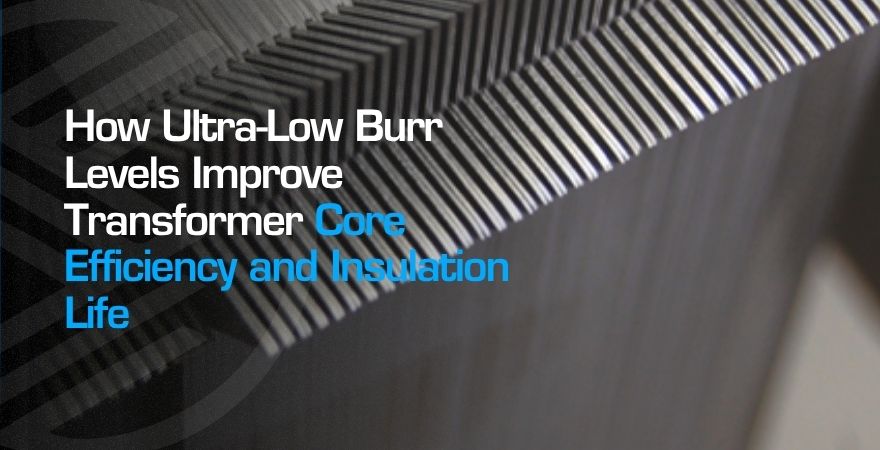
In transformer core manufacturing, burr levels are often underestimated—but they play a critical role in determining efficiency, insulation reliability, and long-term performance. Burrs are small raised edges formed during cutting or slitting of CRGO steel laminations. While microscopic, their impact is significant.
Why Burr Levels Matter
When laminations are stacked to form a core, burrs can:
- damage insulation coating
- create unintended electrical contact between sheets
- increase eddy current losses
- disrupt magnetic flux flow
Even minimal burr presence can lead to localized heating, higher losses, and reduced efficiency.
Impact on Efficiency
1. Increased Eddy Current Losses
Burrs can create conductive paths between laminations, allowing eddy currents to circulate more freely—resulting in higher core losses.
2. Magnetic Disruption
Uneven edges affect stacking uniformity, introducing air gaps and disturbing magnetic flux continuity.
Impact on Insulation Life
Transformer cores rely on insulation between laminations to prevent current flow. Burrs compromise this insulation, leading to:
- premature insulation degradation
- hotspot formation
- reduced transformer lifespan
Why Ultra-Low Burr Is Critical
Maintaining ultra-low burr levels ensures:
- clean lamination stacking
- effective insulation separation
- consistent magnetic performance
- reduced long-term losses
How Sarjani Coretech Delivers Precision
Sarjani Coretech ensures ultra-low burr standards through:
- precision slitting and cutting processes
- controlled tool maintenance
- strict quality inspection
- consistent process discipline
This results in laminations that support efficient, reliable transformer performance over decades.
Conclusion
Ultra-low burr levels are not just a quality parameter—they are a performance necessity. By ensuring clean edges and insulation integrity, manufacturers can significantly improve efficiency and extend transformer life.