
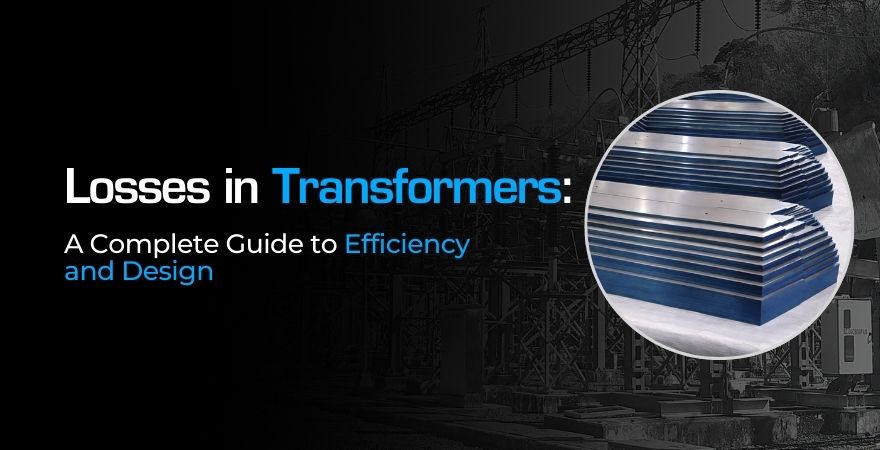
The core of a transformer is laminated to reduce energy losses in transformer caused by eddy currents parasitic currents induced within the solid core material by the alternating magnetic field. By constructing the core from thin, insulated layers of electrical steel (such as CRGO steel), these currents are minimized, leading to a cooler, more efficient and longer-lasting transformer.
Table of Contents
1. The Problem: Eddy Currents in Solid Cores
2. The Solution: The Lamination Principle
3. Key Factors in Transformer Lamination Design
4. Transformer Lamination Material: The Heart of the Matter
5. Choosing the Right Transformer Core Lamination Thickness
6. Step-by-Step: How a Laminated Core Improves Transformer Performance
7. Conclusion: The Essential Role of a Quality Transformer Lamination Core
8. People Also Ask (Your Questions, Answered)
The Problem: Eddy Currents in Solid Cores
Imagine the transformer core as a highway for magnetic flux. When this flux alternates (AC current), it acts like a powerful magnet moving inside the core material itself. In a solid block of steel, this changing magnetic field induces large, circular voltages within the core think of these as unwanted electrical shortcuts. These voltages drive eddy currents, which swirl through the core.
The consequences are severe:
● Energy Loss (I²R Loss): Eddy currents convert useful electrical energy into wasted heat.
● Reduced Efficiency: This heat represents power that doesn’t reach the output.
● Overheating & Damage: Excessive heat can degrade insulation and shorten transformer lifespan.
The Solution: The Lamination Principle
Lamination is an elegant engineering solution. Instead of one solid block, the transformer lamination core is built from hundreds of thin, insulated sheets or laminations, stacked together.
How it works:
1. The Insulation Barrier: Each lamination is coated with a thin, non-conductive layer (C-5 coating, oxide layer).
2. Blocking the Path: This insulation breaks the path for large, cross-sectional eddy currents.
3. Containing the Currents: Any induced currents are now confined to the small area of each individual lamination, drastically reducing their magnitude and the resulting heat.
The key takeaway: A transformer core laminated with insulated sheets is fundamentally more efficient than a solid core.
Key Factors in Transformer Lamination Design
| Attribute | What It Is | Why It Matters |
| Material | The type of electrical steel used (e.g., CRGO). | Determines magnetic permeability and core loss. |
| Thickness | The gauge of each individual steel sheet. | Thinner laminations reduce eddy currents more effectively. |
| Geometry | The shape and cut of the laminations (E-I, U-I, mitred). | Affects magnetic path length, stacking factor and manufacturing ease. |
Transformer Lamination Material: The Heart of the Matter
The choice of transformer lamination material is critical. Cold Rolled Grain Oriented (CRGO) silicon steel is the industry standard for power and distribution transformers.
Why CRGO?
● Grain Orientation: The steel’s crystalline structure is aligned during manufacturing, offering a low-reluctance path for magnetic flux along the rolling direction.
● High Silicon Content: Increases electrical resistivity, which naturally impedes eddy currents.
● Superior Magnetic Properties: Delivers high permeability and saturation flux density with exceptionally low core loss (W/kg).
This specialized material, when used as laminations, is what makes a modern transformer core laminated for peak performance.
Choosing the Right Transformer Core Lamination Thickness
Transformer core lamination thickness is a precise balance between performance and practicality.
● Thinner Laminations (e.g., 0.23mm, 0.27mm): Provide the greatest reduction in eddy current loss. Ideal for high-frequency applications or premium efficiency transformers.
● Thicker Laminations (e.g., 0.30mm, 0.35mm): Offer better mechanical rigidity and a higher stacking factor (more core material per volume), often used in large power transformers where structural strength is paramount.
The Trend: The drive for higher energy efficiency (e.g., Tier 2, Tier 3 standards) is pushing the industry toward thinner, high-grade CRGO laminations to minimize total core loss.
Step-by-Step: How a Laminated Core Improves Transformer Performance
1. Alternating Flux is Applied: The primary winding creates a constantly changing magnetic field.
2. Voltage is Induced in the Core: This field induces a voltage within the core material itself.
3. Laminations Restrict Current Flow: The insulation between each sheet of the transformer lamination core blocks large circulating currents.
4. Eddy Currents are Minimized: Currents are limited to tiny loops within each lamination’s thickness.
5. I²R Losses Plunge: With current (I) drastically reduced, the resistive heating loss (I²R) falls exponentially.
6. Efficiency Rises: More input energy is transferred to the secondary winding as useful output.
7. Temperature Stays Low: Reduced heat generation allows for safer operation and longer insulation life.
8. Reliability Soars: A cool, efficient transformer core laminated with precision ensures decades of reliable service
The Essential Role of a Quality Transformer Lamination Core
Lamination is not an optional feature; it is the fundamental design principle that makes practical, efficient AC transformers possible. The synergy between advanced transformer lamination material like CRGO steel and precise transformer core lamination thickness is what defines transformer performance, efficiency and longevity.
At Sarjani Coretech, we master this synergy. We provide precision-engineered laminations and cores that are optimized for low loss and high reliability, ensuring your transformers meet the most demanding efficiency standards. Choose the right foundation, choose a properly laminated core.
Ready to specify your core? Contact our experts today to discuss the optimal lamination material and design for your transformer project.
FAQs
1. What happens if a transformer core is not laminated?
An unlaminated solid core would have enormous eddy current losses, causing extreme overheating, very low efficiency (likely below 50%), and rapid failure.