
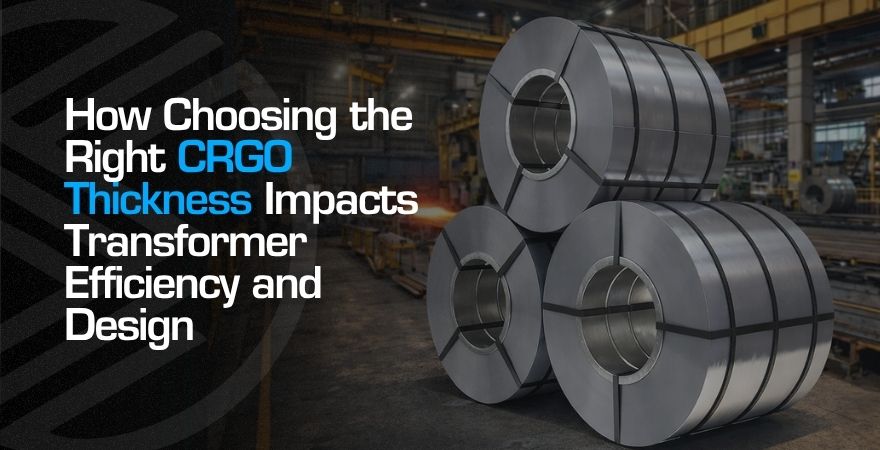
In transformer core manufacturing, material selection goes beyond choosing the correct grade of CRGO (Cold Rolled Grain Oriented) electrical steel. One of the most critical technical decisions is selecting the appropriate CRGO thickness. This parameter directly influences core losses, magnetic performance, mechanical design, and overall transformer efficiency.
For transformer manufacturers aiming to balance cost, performance, and compliance with efficiency standards, CRGO thickness is not just a specification—it is a strategic design choice.
Why CRGO Thickness Matters
CRGO steel is engineered to guide magnetic flux efficiently along a preferred grain direction. However, its thickness determines how effectively it minimizes eddy current losses within the core.
When alternating magnetic flux passes through the core, it induces circulating currents inside the steel laminations—known as eddy currents. The magnitude of these losses is proportional to the square of the lamination thickness.
Thinner Laminations = Lower Eddy Current Losses
Using thinner CRGO laminations (for example, 0.23 mm instead of 0.27 mm) reduces eddy current losses significantly. This improves no-load efficiency and helps transformers meet stringent energy regulations.
Thicker Laminations = Structural Advantage
Thicker laminations offer improved mechanical rigidity and may reduce material cost. However, they typically result in higher core losses compared to thinner grades.
Selecting the right thickness depends on the transformer’s application, performance target, and cost optimization strategy.
Impact on Transformer Design
1. Core Loss Optimization
Reducing lamination thickness lowers no-load losses, which is especially important for distribution transformers that operate continuously under low load conditions.
2. Thermal Management
Lower core losses mean less heat generation. This improves insulation life and reduces cooling requirements.
3. Core Size and Weight
Thinner laminations may allow optimized core designs that balance magnetic performance with compactness.
4. Compliance with Efficiency Standards
Global energy regulations increasingly demand higher efficiency levels. Proper CRGO thickness selection plays a key role in meeting these standards without excessive design modifications.
The Trade-Off: Cost vs Performance
While thinner CRGO laminations provide better efficiency, they may increase material and processing costs. Manufacturers must evaluate:
- Application type (distribution vs power transformer)
- Required efficiency rating
- Operating load profile
- Lifecycle cost considerations
The true cost of CRGO thickness is not just purchase price—it is long-term energy performance.
Why Precision Processing Is Critical
Selecting the right thickness is only the first step. Improper slitting, high burr levels, or coating damage can offset the theoretical efficiency advantages of thinner CRGO steel.
Key process factors include:
- Controlled slitting to minimize mechanical stress
- Ultra-low burr formation
- Protection of insulation coating
- Dimensional consistency across batches
Without precision processing, the expected efficiency gains may not be realized in finished transformer cores.
How Sarjani Coretech Delivers Optimized CRGO Processing
Sarjani Coretech supports transformer manufacturers by combining proper material selection with disciplined manufacturing control.
Precision Slitting Across Thickness Variants
Sarjani maintains tight tolerances while processing different CRGO thickness grades, ensuring dimensional accuracy and preserved magnetic properties.
Ultra-Low Burr Discipline
Strict burr control enhances stacking quality and protects insulation, especially important for thinner laminations.
Coating Integrity Protection
Careful handling ensures insulation coating remains intact, preventing inter-laminar losses.
Batch-to-Batch Consistency
Uniform processing standards ensure predictable performance across production cycles—critical for OEMs targeting high-efficiency ratings.
Integrated Core Supply Capability
From CRGO full-width coils to slit coils, laminations, and ready core assemblies, Sarjani provides end-to-end core solutions aligned with efficiency-driven design.
Conclusion
Choosing the right CRGO thickness directly impacts transformer efficiency, heat management, and long-term performance. Thinner laminations reduce eddy current losses and improve compliance with modern energy standards, while proper processing ensures these theoretical benefits translate into real-world results.
By combining technical expertise, precision slitting, and consistent quality control, Sarjani Coretech enables transformer manufacturers to optimize core design and deliver reliable, efficient performance—right from the material stage.