
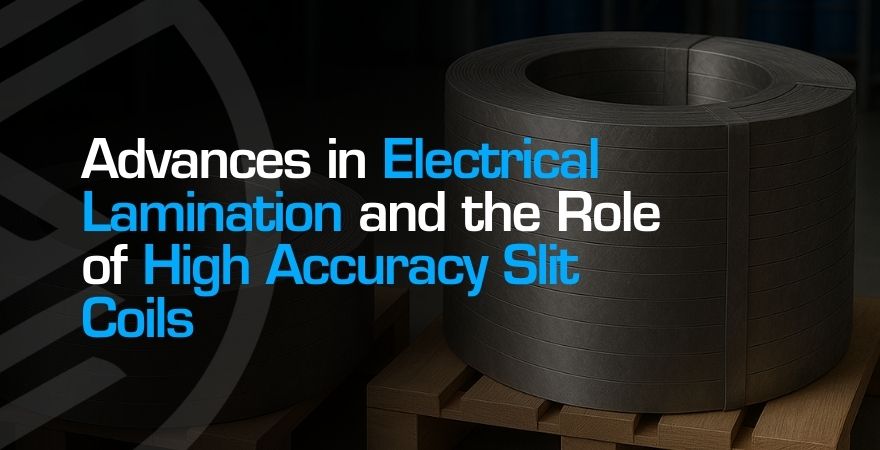
Modern transformer performance depends on electrical lamination that offers stable magnetic flow and reduced losses supported by consistent slit coil accuracy
Electrical lamination has become the foundation of high efficiency transformer design due to increasing global demand for energy conservation. The power sector is moving toward compact designs that require dependable magnetic performance, lower losses, and long term stability. These outcomes are possible only when electrical lamination is processed with accuracy, uniformity and strict control at every stage.
Electrical lamination governs the path of magnetic flux inside the core. Any variation in slit width, burr level, or coating condition interrupts this path and increases core losses. With transformer manufacturers focusing on star rated performance, electrical lamination now receives the same level of attention as material grade selection.
Why electrical lamination accuracy matters
Loss reduction is the highest priority in transformer manufacturing. Electrical lamination allows the magnetic flux to travel smoothly without disturbance. When slit coils lack accuracy, the lamination stack experiences gaps, uneven edges, and surface strain which directly raises no load losses. A precise electrical lamination stack provides a compact and uniform magnetic circuit that enhances efficiency.
High accuracy also supports mitred and rectangular core designs. These designs are sensitive to dimensional variation. Any change in the lamination size or surface finish can distort the geometry and allow flux leakage. EL produced from stable slit width coils helps maintain perfect alignment and reliable performance.
High accuracy slit coils and their growing importance
Slit coils are now treated as performance components rather than simple cut strips. High accuracy slit coils bring consistent width, minimal burr, controlled edges, and smooth surfaces which define the quality of electrical lamination. When slit coils meet close tolerance standards, the resulting electrical lamination stack becomes free from stress points, hotspots, and unwanted vibration.
Uniform surface finish also protects the insulation coating, which is essential for reducing eddy currents. This improves the reliability of EL lamination during continuous load conditions.
Material evolution and its link to electrical lamination
The sector widely uses CRGO grades such as M3, M4, M5, and M6 along with Hi B grade materials. These steels offer lower watt loss and higher permeability. Their performance, however, depends entirely on the quality of EL lamination produced from them. Even the best CRGO coil will underperform if the slitting accuracy is poor.
Modern plants use advanced slitting technology that protects the coating, maintains edge stability, and produces laminations that stay consistent from the first piece to the last.
Impact on transformer performance
Accurate electrical lamination results in:
- Better magnetic properties
- Lower core losses
- Reduced noise
- Higher thermal stability
- Longer core life
- Improved mechanical strength
As transformer manufacturers shift toward smart grid requirements and higher efficiency ratings, electrical lamination will continue to influence performance outcomes.
Sarjani Coretech and its contribution to advanced electrical lamination quality
Sarjani Coretech provides high accuracy slit coils and premium CRGO laminations that support the efficiency needs of distribution and power transformer manufacturers. The company focuses on strict width accuracy, clean edges, minimal burr, and surface care that enhance electrical lamination performance across all power grades. Mitred and rectangular laminations are produced with consistent geometry to support stable core assembly and reduced losses.
Sarjani Coretech remains committed to supplying EL lamination that meets modern efficiency targets while ensuring dependable magnetic performance for every transformer design.